The frontier problem is not capability. It is governability at runtime.
AI systems operate at machine speed across complexity levels that exceed human cognitive bandwidth for continuous runtime comprehension. The asymmetry is not authority — it is velocity and dimensional complexity.

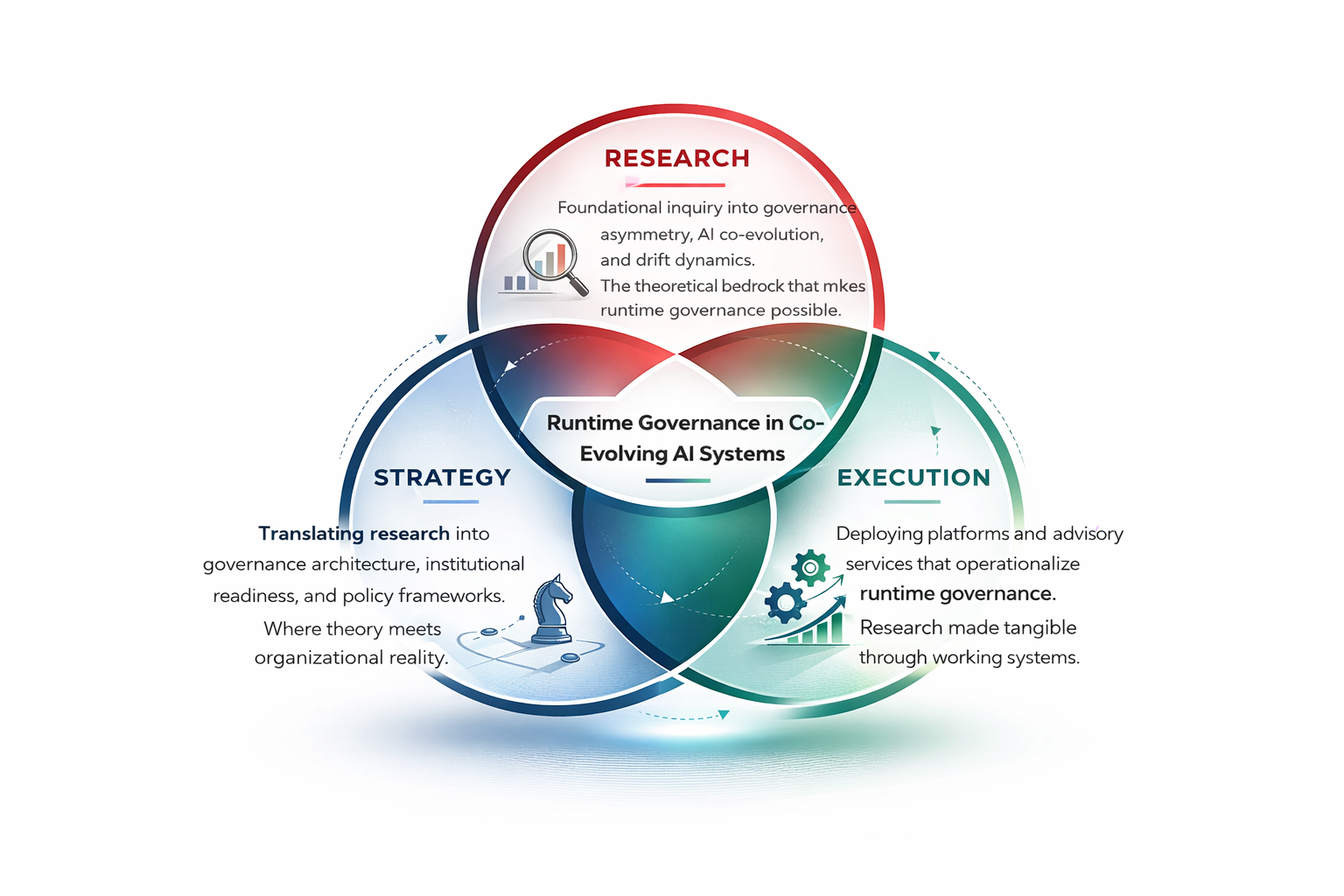
Runtime Governance in Co-Evolving AI Systems
Research
Original frameworks on governance asymmetry, co-evolution dynamics, and runtime governance architectures — published, cited, and openly available.
Explore Research →Strategy
Advisory for enterprises, institutions and regulators: governance architecture design, maturity assessment, and roadmaps that move from policy to runtime.
Explore Strategy →Execution
SaaS platforms that operationalize governance at machine speed — turning the framework into running systems inside real deployments.
Explore Execution →AiSuNe operates at the intersection of research, strategy and execution. As AI systems and human institutions co-evolve, governance must evolve with them — from static policy to continuous runtime architecture.
The condition that emerges when AI decision velocity and system dimensionality exceed human capacity for real-time comprehension of cascading downstream effects. The asymmetry is not authority — humans retain authority. The asymmetry is velocity and the complexity of consequence propagation.
Current governance models were designed for slower technology cycles. AI systems evolve continuously — through retraining, fine-tuning, emergent interaction and deployment-context drift. Static compliance frameworks cannot address systems whose behaviour changes after certification.
The gap between what AI systems do at runtime and what governance frameworks assume they do is not a temporary lag. It is a structural condition that requires a fundamentally different approach to governance.
Key Concepts
Governance Asymmetry
The structural mismatch between AI decision velocity and institutional governance capacity. Not a temporary gap — a persistent condition requiring architectural response.
Drift
The gradual divergence of AI system behaviour from its intended design parameters over time and across deployment contexts. Drift is not failure — it is an inherent property of adaptive systems.
Co-Evolution
The reciprocal adaptation between AI systems and the human institutions that deploy, regulate, and interact with them. Neither side evolves in isolation.
Runtime Governance
Continuous, adaptive governance applied to AI systems during operation — not just at design time or through periodic audits. Governance that runs at the speed of the system it governs.
Platforms
AiSuNe Cora
The foundation of agentic AI — ensuring correct, complete, and consistent answers for highly regulated and safety-critical industries.
Explore →AiSuNe Space
The AI-driven teams platform — unifying human and AI collaboration for greater speed, clarity and coordination.
Explore →AiSuNe Studio
The admin tool for all AiSuNe SaaS offerings — a single control plane to configure, monitor and manage your deployment, including cryptographic transition readiness.
Explore →AiSuNe Risk
Risk management and monitoring — continuous assessment and automated response across complex AI deployment environments.
Explore →AiSuNe Governance Twin
Living governance for operations — real-time oversight that evolves with your AI systems without impeding velocity.
Explore →Who This Is For
Enterprise
CTOs, CDOs and CISOs deploying AI at scale who need runtime governance infrastructure — not another compliance checklist.
Government & Regulatory
Regulatory bodies and public agencies seeking frameworks for governing AI that evolves post-deployment and operates beyond audit cycles.
Academia & Research
Researchers and institutions advancing the science of AI governance, co-evolution, drift dynamics, and human-AI interaction.
NGOs & Civil Society
Civil society organizations working on AI accountability, ethical deployment, and ensuring governance remains accessible and non-proprietary.